

Diversify Globally
Why International ETFs Deserve a Look in 2025

The S&P 500’s recent run has investors on edge. With a trailing price-to-earnings (P/E) ratio climbing to 27.5 as of March 2025 (per S&P Global data), the index looks richly valued—well above its historical average of 20. Worse, market cap weighting is heavily concentrated: mega-caps like Apple, Microsoft, Nvidia, Google, Amazon, Meta, Broadcom, Berkshire Hathaway, and Tesla now account for over one-third of the index, per iShares Core S&P 500 ETF (IVV) holdings. Tech alone makes up 30% of the S&P 500, a volatile sector prone to sharp swings. Add in Trump’s tariffs—25% on Canada/Mexico, 10% on China—and US-focused portfolios face real risks. International ETFs offer a diversification play, often with higher dividend yields. Lately, it’s been popular to phase out international stocks due to the S&P 500’s outperformance over the past decade (up ~200% vs. MSCI EAFE’s ~70%, per Morningstar), as US companies offer healthy international sales—e.g., Apple’s 60% overseas revenue. Warren Buffett echoes this, favoring US equities with global reach, like Coca-Cola. Yet, while the US remains one of the best countries for business, recent market trends—high valuations and concentration—justify keeping broad exposure. The classic portfolio strategy suggests an 80/20 US/International split. Pairing a broad US fund like Vanguard Total Stock Market ETF (VTI), SPDR Portfolio S&P 1500 Composite Stock Market ETF (SPTM), or Schwab U.S. Broad Market ETF (SCHB) with an international ETF diversifies risk. Let’s break down six options: VXUS, SPDW, SPEM, SCHF, VYMI, and IGRO.
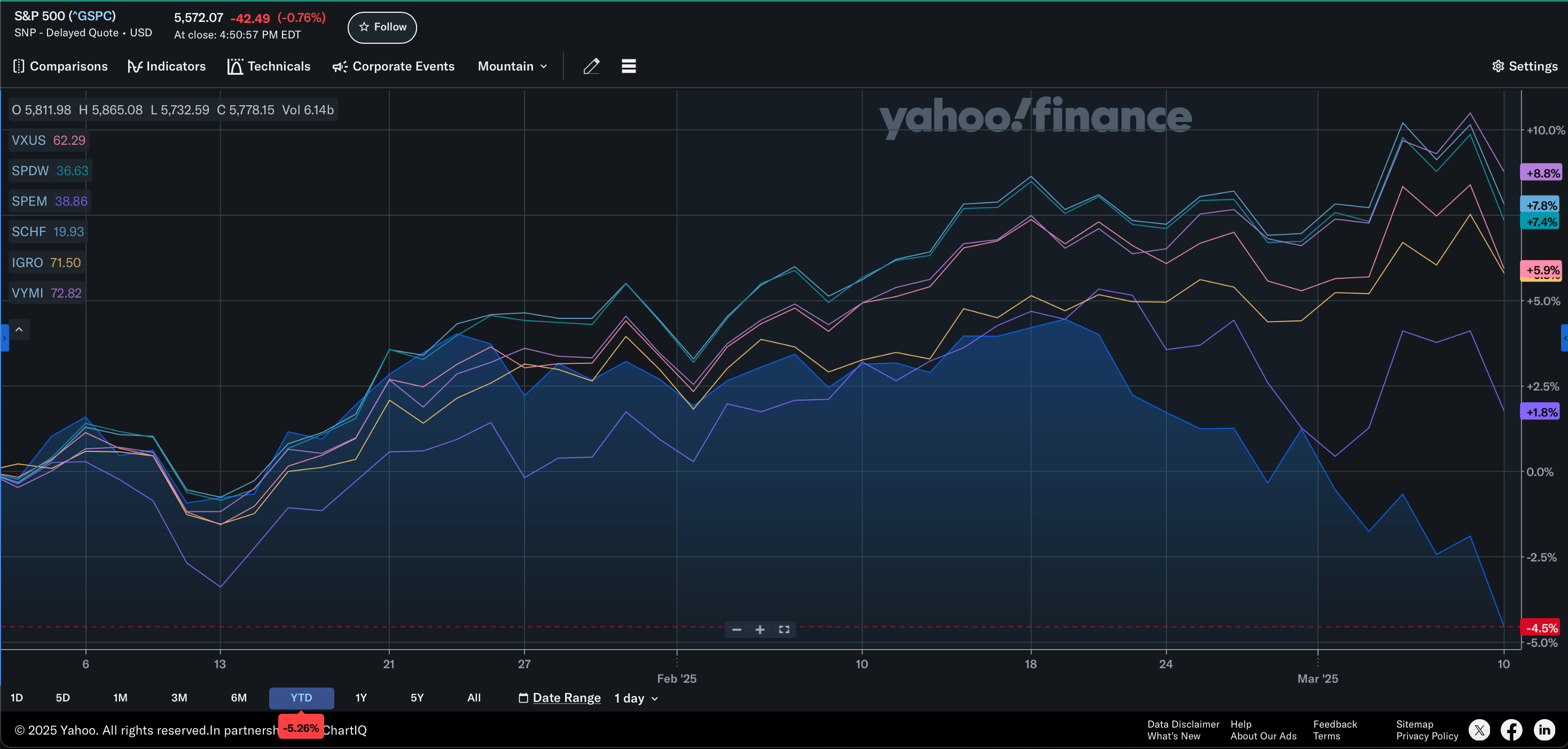
S&P 500 Dividend Yield Baseline
The S&P 500’s dividend yield is a modest 1.3% (IVV data, March 2025), squeezed by high valuations and tech’s low payout focus. International ETFs often beat this, alongside broader exposure.
1. Vanguard Total International Stock ETF (VXUS)
Objective: Tracks the FTSE Global All Cap ex US Index, covering 99% of non-US market cap—developed and emerging markets.
Dividend Yield: ~3.1% (trailing 12 months, Vanguard data). More than double the S&P 500’s yield.
Country Exposure: Top weights: Japan (15%), UK (9%), China (8%), Canada (7%), India (5%).
Sector Exposure: Financials (22%), industrials (15%), tech (14%)—less tech-heavy than the S&P 500.
Expense Ratio: 0.05%. Dirt cheap for global exposure.
Top Holdings: Taiwan Semiconductor (2.5%), Tencent (1%), SAP (1%).
Top 10 Holdings (9.53% of Total Assets)
VXUS is a one-stop shop for global diversification, with 8,000+ stocks. Its low tech weighting reduces volatility compared to the S&P 500, and the yield offers income.
2. SPDR Portfolio Developed World ex-US ETF (SPDW)
Objective: Tracks the S&P Developed Ex-US BMI Index, focusing on developed markets outside the US.
Dividend Yield: ~3% (SPDR data). Nearly double the S&P 500.
Country Exposure: Japan (20%), UK (11%), Canada (9%), France (8%), Switzerland (6%).
Sector Exposure: Financials (22%), industrials (18%), tech (11%), consumer cyclical (10%).
Expense Ratio: 0.03%. One of the lowest in its class.
Top Holdings: Novo Nordisk (1.2%), ASML Holdings (1.1%), SAP (1.1%).
Top 10 Holdings (10% of Total Assets)
SPDW excludes emerging markets, focusing on stability. Its low tech exposure (10%) contrasts with the S&P 500’s 30%, and Canada’s 9% weighting ties into the U.S. tariff focus—watch for trade policy impacts.
3. SPDR Portfolio Emerging Markets ETF (SPEM)
Objective: Tracks the S&P Emerging BMI, targeting emerging markets like China, India, and Brazil.
Dividend Yield: ~2.7% (SPDR data). Beats the S&P 500.
Country Exposure: China (30%), India (20%), Taiwan (15%), Brazil (5%), South Africa (3%).
Sector Exposure: Financials (22%), tech (21%), consumer cyclical (13%).
Expense Ratio: 0.07%. Competitive for emerging markets.
Top Holdings: TSMC (8.3%), Tencent (4.2%), Alibaba Group (2.8%).
Top 10 Holdings (22.8% of Total Assets)
SPEM offers growth potential but higher risk—China’s 30% weighting faces Trump’s 10% tariff (~$43B cost on ~$430B exports, per our previous trade article linked below). Tech at 21% adds volatility, though less than the S&P 500. Highest concentration in the top 10 holdings among the international funds on our list at 22.8%, adding to the potential volatility.
4. Schwab International Equity ETF (SCHF)
Objective: Tracks the FTSE Developed ex US Index, covering developed markets excluding the US.
Dividend Yield: ~3% (Schwab data). Solid income play.
Country Exposure: Japan (22%), UK (12%), Canada (10%), France (8%), Germany (6%).
Sector Exposure: Financials (23%), industrials (17%), tech (11%), healthcare (11%).
Expense Ratio: 0.06%. Ultra-low cost.
Top Holdings: SAP (1.4%), ASML (1.3%), Novo Nordisk (1.3%).
Top 10 Holdings (11.3% of Total Assets)
SCHF is a direct competitor to SPDW, with similar exposure but slightly higher Japan weighting. Its 9% tech allocation reduces volatility, and Canada’s 10% exposure flags tariff risks.
5. Vanguard International High Dividend Yield ETF (VYMI)
Objective: Tracks the FTSE All-World ex US High Dividend Yield Index, targeting above-average dividend yields in developed and emerging markets.
Dividend Yield: ~4.5% (Vanguard data). Over three times the S&P 500—ideal for income seekers.
Country Exposure: Japan (14%), UK (10%), China (9%), Canada (8%), Australia (7%).
Sector Exposure: Financials (39%), industrials (9%), energy (9%), consumer cyclical (8%).
Expense Ratio: 0.17%. Higher but justified by the yield focus.
Top Holdings: Roche Holdings (1.7%), Toyota (1.7%), Nestlé (1.6%).
Top 10 Holdings (14.3% of Total Assets)
VYMI’s high yield and low tech exposure make it a defensive play. To help achieve its high yield, the fund is highly concentrated in the Financials sector relative to others. Energy at 9% ties to the tariff risk—Canada’s oil exports face a 10% hit, but VYMI’s global spread mitigates risk.
6. iShares International Dividend Growth ETF (IGRO)
Objective: Tracks the Morningstar Global ex-US Dividend Growth Index, focusing on firms with consistent dividend growth outside the US.
Dividend Yield: ~2.3% (iShares data). Still beats the S&P 500.
Country Exposure: Japan (18%), Canada (12%), UK (10%), Switzerland (8%), China (6%).
Sector Exposure: Financials (26%), health care (16%), utilities (13%), industrials (13%).
Expense Ratio: 0.15%. Reasonable for a growth-dividend focus.
Top Holdings: Roche (3.4%), Nestlé (3.4%), Sanofi (3.4%).
IGRO blends income and growth, with a defensive tilt. Canada’s 12% weighting means tariff exposure, but its lower tech allocation keeps volatility low.
Why Go International Now?
The S&P 500’s 27.5 P/E and 30% tech weighting scream caution—mega-cap concentration (Apple, Microsoft, etc.) makes it a house of cards if tech stumbles. International ETFs offer lower valuations (e.g., VXUS P/E ~14), higher yields (2.5%–4.5% vs. 1.3%), and less tech exposure (8%–20% vs. 30%). Tariffs add another layer—Canada and Mexico face 25% hits, China 10%, per our recent trade articles. ETFs like SPEM (30% China) carry risk, but diversified options like VXUS or VYMI spread it out. The past decade’s S&P 500 outperformance (~200% vs. MSCI EAFE’s ~70%, per Morningstar) has fueled a trend to ditch international stocks, as US firms like Apple (60% overseas sales) and Coca-Cola provide global exposure. Warren Buffett prefers this approach, betting on US equities with strong international operations. Yet, with the US still a top business hub, the S&P 500’s concentration and tariff risks suggest keeping some international exposure. The classic 80/20 US/International portfolio—pairing VTI, SPTM, or SCHB with an ETF like VXUS or VYMI—balances this, reducing reliance on a tech-heavy US market.
The Bottom Line
International ETFs are a smart hedge in 2025. VYMI’s 4.5% yield suits income seekers, while Vanguard’s VXUS offers total market exposure at 0.05% cost. SPDW and SCHF are low-cost developed market plays, SPEM taps emerging growth, and IGRO balances growth and dividends. With the S&P 500 looking frothy, global diversification could be your portfolio’s best move. Always consider consulting with your financial advisor or trusted financial professional to select the appropriate mix for you. What’s your favorite international ETF?
Follow here at Substack or on X @4CornersFinance for more.
Check our prior article on US trade and tariffs mentioned above: